Why Your Internship Will Teach You More Than Any Classroom
Most graduates remember the moment.
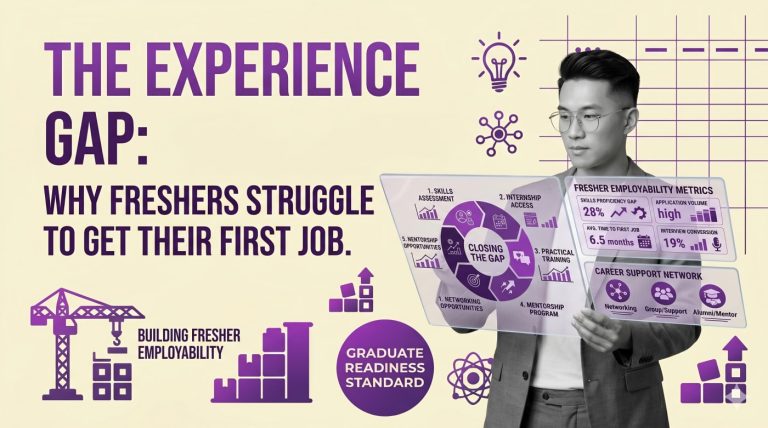
You have done the years, the exams, and the late-night cramming. You have the certificates to prove it. And then your first real week at work arrives, and something quietly hits you: nobody actually prepared you for this. Not the textbooks. Not the lectures. Not the grades.
That gap between knowing something and actually being able to do it? That is what internships exist to close.
The Difference Nobody Really Talks About
School teaches you what. Experience teaches you how. And they are not the same thing, not even close.
Think about how much time you spend in education learning theory, frameworks and concepts. You memorize definitions, you analyze case studies written by someone else, and you answer exam questions about scenarios that never quite match reality. And all of that is genuinely useful. It gives you vocabulary. It gives you context. It gives you a foundation to build on.
But foundations are not the building. They are just the starting point.
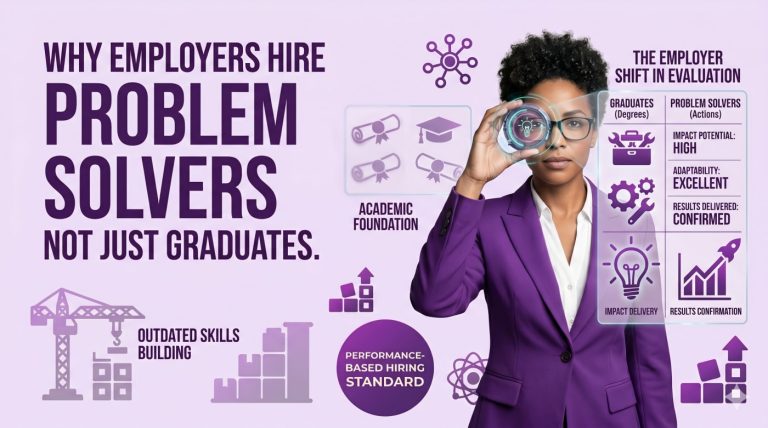
Most recruiters already know this. When they are weighing up two candidates, one loaded with qualifications and the other with fewer certificates but a handful of real projects behind them, they will usually go with the second person. Not because that person knows more. Because they have done more.
Reading about swimming and actually being in the water are different things. You can study every stroke technique, watch hours of training footage, and understand the physics of buoyancy. And then you jump in and discover that none of it fully prepared you for what it actually feels like to move through water. The same is true of work.
What a Good Internship Actually Looks Like
Someone hands you a problem. There is no answer key at the back. The deadline matters to other people, not just your grade. The team is counting on you. Your manager is stretched thin and cannot repeat themselves. And somehow, you work it out.
Not perfectly. But you work it out.
That process, the confusion, the wrong turns, the small wins, is where the real learning sticks. It embeds itself in a way that a semester of theory rarely does. Because the stakes are real. Because other people are involved. Because you are not being assessed in a controlled environment designed to give you the best possible chance of succeeding. You are just doing the work, with all the messiness and ambiguity that comes with it.
A good internship forces you to make decisions. It forces you to communicate. It forces you to take responsibility for your own output in a way that sitting in a lecture hall never can. And when things go wrong, which they will, you learn how to recover. That in itself is one of the most valuable things anyone can learn.
The Things That Never Make It Into the Curriculum
A good internship quietly teaches you things that do not appear on any syllabus. They are rarely mentioned in career talks and almost never assessed in any formal sense. But they are the things that actually determine how far you go in your career.
Learning how to explain your reasoning to someone who does not share your background is one of them. In education, you write for people who already understand the subject. In the real world, you explain your thinking to colleagues, clients, managers, and stakeholders who come from completely different disciplines and have completely different priorities. The ability to translate your ideas clearly for someone outside your area is a genuinely rare skill, and the only way to develop it is to practice it.
Learning how to make a call when there is no obviously right answer is another. Education trains you to find the correct solution. Work often requires you to make the best available decision with incomplete information and a deadline looming. That is a completely different mental muscle. It feels uncomfortable at first. Internships give you a safe enough environment to start building it before the stakes are too high.
Then there is what it feels like when your work genuinely matters to other people. This sounds simple, but it changes something in you. When a task you complete actually moves a project forward, when a piece of analysis you produced gets used in a real meeting, or when something you built gets launched and people actually use it, that is a different kind of satisfaction than getting a good mark. It is motivation that comes from the work itself, not from external validation. Discovering that feeling early is incredibly powerful.
Learning how to collaborate with someone you would never have chosen yourself is something university tries to replicate with group projects but rarely manages to fully capture. In a workplace, you do not get to pick your team. You work with people who think differently, communicate differently, and have different strengths and different blind spots. Getting genuinely good at that is a career-long skill, and the earlier you start, the better.
And then there is learning how to pick yourself back up when something goes sideways. Because it will. No internship goes perfectly. No project runs exactly to plan. How you respond when things do not work out, how quickly you regroup, and how clearly you communicate what happened and what you are doing to fix it—that is often what people remember about you most.
People call these soft skills. They are not soft. They are the actual jobs.
The Thing Nobody Tells You Before You Start
Most people assume internships are mainly about getting hired. And yes, that is part of it. A meaningful internship gives you something concrete to put on your CV, gives you people who can speak to your abilities in a credible and specific way, and gives recruiters evidence that you can actually function in a professional environment.
But the bigger thing, the one that catches people off guard, is that you find out what you actually enjoy. That might sound obvious, but it is remarkable how many people spend years studying something and then discover, only once they are actually doing it, that it is not what they imagined at all.
Some people do their first internship in data and realize they love it in a way they never expected. The patterns, the problem-solving, the ability to pull insight out of raw numbers. They come in uncertain, and they leave knowing exactly what they want to spend their time on.
Others land in product management and feel immediately at home. The combination of strategy, empathy for users, cross-functional collaboration, and constant prioritization turns out to suit them perfectly. They might have spent years assuming they were destined for a technical role, only to discover that their real strength is in working across teams and translating between different groups of people.
And some people find out early, mercifully, that the field they have been studying is not really for them. That can feel like a failure in the moment. It is not. It is one of the most useful pieces of information you can have. Knowing where you want to go before you have spent years heading in the wrong direction is worth more than most people give it credit for. Changing course at 22 is a very different situation to changing course at 32.
Internships give you that data. They let you test assumptions about yourself and the kind of work you want to do in a way that is low-stakes enough to recover from if the answer is not what you hoped.
The Broader Shift in What Employers Actually Value
Knowledge has never been more available. Any concept, any skill, any course is a search away. You can learn almost anything online, for free or close to it, at your own pace, in your own time. The information gap that once separated people with access to good universities from those without has narrowed dramatically.
What has not become more available is proof that you can actually use any of it.
Anyone can say they understand project management. Anyone can list communication skills on a CV. What sets people apart is evidence. A project you led. A problem you helped solve. A team you contributed to in a meaningful way. A result you can point to and explain.
That is why the question has shifted. It used to be, “What did you study?” Now it is more often What have you built? What have you shipped? What have you actually done?. Employers are increasingly looking for evidence of capability, not just credentials. And internships are one of the few ways that young people, early in their careers, can generate that kind of evidence before they have had the opportunity to accumulate years of full-time experience.
This shift is not going to reverse. If anything, it is going to accelerate. The more qualifications proliferate, the less each individual qualification differentiates you. Experience becomes the thing that sets people apart precisely because it cannot be easily replicated, cannot be acquired overnight, and cannot be faked.
Why Starting Early Matters More Than People Realise
There is sometimes a temptation to wait until you feel ready. To want one more year of study, one more course, and one more qualification before stepping out into the professional world and taking on a real role. It feels like preparation. It is often avoidance.
The truth is that you will not feel ready. Almost nobody does the first time they walk into a workplace and sit down at a desk that is now theirs to manage. Readiness is not something you can manufacture through additional study. It is something that develops through experience, and experience requires showing up before you feel ready.
The people who benefit most from internships are usually the ones who do them earlier than feels comfortable. They stumble a bit more at the start. They ask more questions. They make more recoverable mistakes. And they come out the other side significantly more capable than they would have been if they had waited.
There is also a compounding effect to starting early. The skills you build in your first internship make you better at your second. The confidence you develop there makes you more effective in your first full-time role. The network you build along the way opens doors that would otherwise have stayed closed. Every real experience you accumulate makes the next one richer and more productive.
One Last Honest Thought
Years from now, you probably will not remember much from the textbooks. You might remember a few lectures that genuinely surprised you or shifted how you thought about something. But mostly, what you will carry forward from your years of study is the general shape of a discipline, some vocabulary, and some ways of thinking.
What you will remember far more vividly is the first project you shipped. The first time a client said yes. The first time a manager trusted you with something that actually mattered. The first team you were genuinely part of, not as a student observing from the edges but as someone with a real role to play.
Those moments do not just build skills. They change how you see yourself. You stop being someone who is learning about work, and you become someone who is actually doing it. That shift in identity, from student to practitioner, from observer to contributor, is the whole point.
The certificate tells people you turned up. The experience tells them who you are.