The Degree Is No Longer the Finish Line: Why Problem-Solving Is the Most Valuable Skill You Can Have Right Now
Let’s be honest about something most people don’t want to say out loud: the degree isn’t doing what it used to do.
For years, the plan was simple. Study hard, get into a decent college, finish your degree, and walk into a career. Your parents believed it. Your school counsellors repeated it. Every relative at every family gathering asked “so what are you studying?” with the quiet assumption that the answer would determine the trajectory of your life.
And look — it wasn’t completely wrong. For a long time, a degree was a reliable signal. It told an employer that you could show up, do the work, and follow through on something that took three or four years to complete. That still counts for something.
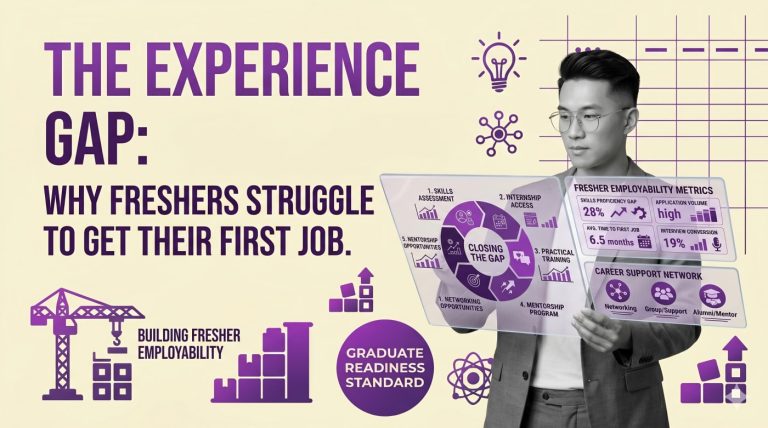
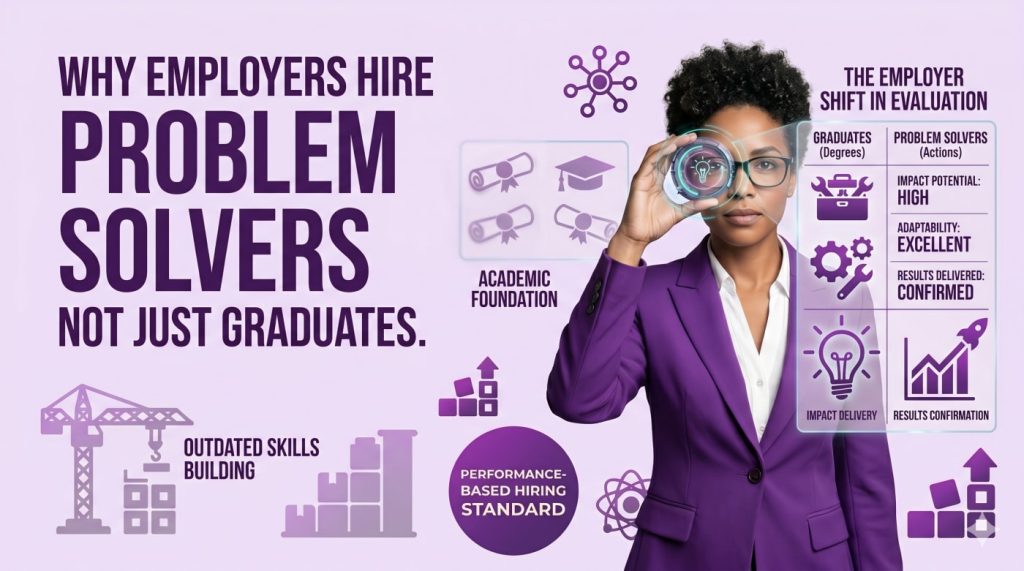
But here’s the problem. Millions of people are graduating every year. The degree has become the floor, not the ceiling. Employers can’t use it to separate people anymore, so they’ve had to find something else to look for. And what they’ve landed on is deceptively simple: can you actually solve problems?
Not theoretically. Not on paper. In real life, when things are messy and unclear and the deadline is tomorrow.
That gap — between people who know things and people who can actually do things — is what this article is about.
The Job Market Has Changed. Most Advice About It Hasn’t.
Think about what’s happened to the world of work in the last decade. Remote work became normal overnight. Entire industries got reshaped by technology. AI went from a buzzword to something that’s already doing jobs people thought were safe. Companies that seemed untouchable collapsed. New ones appeared from nowhere and became essential.
In that environment, the ability to adapt isn’t a nice-to-have. It’s the whole game.
The employers who are hiring right now aren’t just looking for someone who studied the right things. They’re looking for someone who can walk into an unfamiliar situation, make sense of it, and do something useful. Portfolios matter more than transcripts. What you’ve built matters more than what you’ve studied. A candidate who can point to a real project they shipped even a messy, imperfect one is almost always more compelling than someone with a pristine GPA and nothing else to show.
This isn’t a cynical take on education. It’s just where things are. And once you understand it, it actually opens up a lot of possibilities because building real skills is something you can start doing right now, before you finish your degree, before you land your first job, before you have permission from anyone.
Every Business, At Its Core, Is Just Trying to Fix Something
Here’s a reframe that’s useful for thinking about your career: every business in the world exists because someone had a problem they couldn’t ignore.
Healthcare exists because people get sick and need help. Software exists because doing things manually is slow and error-prone. Logistics exists because things need to get from one place to another, and that’s harder than it sounds. Insurance exists because bad things happen and people need a way to handle the financial fallout. Every product you use, every service you pay for, every company you’ve ever heard of behind all of it is a problem someone decided to take seriously.
When a company hires you, they’re not hiring you to fill a role on an org chart. They’re hiring you to help them deal with the headaches the sales numbers that aren’t where they should be, the customer feedback that keeps flagging the same issue, the process that everyone knows is broken but nobody has fixed the technical problem that’s been sitting in the backlog for six months.
Your salary, when you break it down, is basically what the company believes your problem-solving is worth. Not your degree. Not your credentials. The actual value you create by making their problems smaller.
Once you look at work this way, it changes how you think about preparing for it. The question stops being “what should I study?” and starts being “what can I actually fix?”
The Difference Between Graduate A and Graduate B
You’ve probably seen this play out, or you know someone who has.
Graduate A finished at the top of their class. Perfect attendance, near-perfect grades, thoroughly impressive on paper. They can explain theoretical frameworks with confidence and write a well-structured essay on almost any topic in their field. They did everything right, by every metric the education system uses to measure success.
Graduate B had a fine GPA — nothing spectacular. But while Graduate A was perfecting assignments, Graduate B was doing other things. They built a small app for a local shop to track their inventory, even though it was clunky and took three times longer than expected. They joined a startup for six months, mostly doing things that were too junior to be interesting but got them close enough to real decisions to understand how they’re made. They took on a freelance project, quoted the wrong price, delivered anyway, and learned more from that one experience than from an entire semester of coursework.
Most hiring managers, if they’re being honest, will choose Graduate B. Not because grades don’t matter. They do, to a point. But because the world Graduate B has been preparing for looks a lot more like the actual job than the world Graduate A has been preparing for.
The textbook is a controlled environment. Every problem has been designed to be solvable with the tools in that chapter. The variables behave the way the author intended. There are no surprises.
Real work is not like that. Real work is ambiguous. The problem in front of you is often not the actual problem it’s a symptom of something deeper. The information you need to make a good decision is never complete. The people you need to work with don’t always agree, and sometimes they’re wrong about things in ways that are hard to say out loud. And the clock is always running.
Book-smart is a foundation. Solution-ready is the superpower. They’re not opposites but only one of them gets you promoted.
What AI Is Actually Doing to the Workforce (And What It Isn’t)
Let’s talk about AI, because you can’t have this conversation in 2025 without it.
AI is genuinely good at things that used to feel uniquely human. It can write,summarise, code, analyse and generate ideas at a speed and scale that no individual could match. If you’ve been leaning on your ability to recall information, synthesise research, or produce standard outputs quickly, AI is already better at most of that than you are.
That’s not meant to be demoralising. It’s meant to be clarifying.
The question isn’t whether AI will take jobs. It already has, and it will continue to. The real question is: which jobs, and why? The answer, broadly, is the ones built around predictable, repeatable, information-based tasks. The ones where the process is well-defined and the output is standardised.
What AI still genuinely can’t do is messier and more human. It can’t build real trust with a frustrated client who needs to feel heard before they’ll hear anything you’re saying. It can’t walk into a team that’s dysfunctional and figure out why they’re really stuck. It can’t make a judgment call in a situation that doesn’t match any pattern in its training data and then own the outcome of that call. It can’t notice that the problem everyone is arguing about isn’t actually the problem and redirect the conversation without making everyone defensive.
Those things require judgment. They require the kind of contextual awareness that comes from experience and from caring about the outcome. They require accountability which is ultimately a human thing, because you need someone who can be held responsible when things go wrong.
The professionals who will do well in the next decade are the ones who use AI to handle the predictable parts of their work and focus their own energy on the parts that require genuine human thinking. The tool is powerful. The person who knows how to use it purposefully is more powerful.
The Stuff School Never Actually Taught You
Here’s something worth sitting with: most formal education is not designed to teach problem-solving. It’s designed to teach knowledge.
That’s not a failure of educators — it’s a structural thing. A curriculum with clear objectives, assessments with right answers, and grades that measure recall and comprehension that system is reasonably good at transferring information. It’s not designed to create people who can operate in ambiguity.
Think about the skills that actually matter in the workplace, and notice how rarely they appear in a syllabus.
How do you figure out what the real problem is,when everyone around you is confidently solving the wrong one? Diagnosis is a skill. Most people skip it because jumping to solutions feels more productive.
How do you make a decent decision when you don’t have all the information you’d like which is every decision, always? Academic training rewards people who know the answer. Professional life rewards people who can move forward without it.
How do you work with someone who disagrees with you, has more authority than you, and is probably not going to change their mind? Group projects in school have low stakes. The dynamics of a real team, with real consequences, are completely different.
How do you handle failing at something important, learn from it quickly, and come back without spending six weeks recovering your confidence? Academic failure has lasting, official consequences. That teaches people to avoid risk. Workplaces that are actually growing need people who can try things, fail fast, and iterate.
How do you explain a complex technical problem to someone who doesn’t share your vocabulary, in a way that helps them make a good decision? Nobody teaches this explicitly, but it’s one of the most valuable things anyone in a professional role can do.
These skills are largely invisible in formal education. But they’re what experienced hiring managers are actually trying to assess in interviews, and they’re what separates people who grow quickly in their careers from people who plateau early.
You Don’t Have to Wait for a Job to Start Building This
Here’s the good news: you can start building a track record of real problem-solving before anyone gives you permission to.
The idea is simple. Instead of a list of courses and exam results, you build a collection of actual outcomes. Things you made. Problems you worked through. Results you can point to and say, “I did that.”
Start by building something real. Not a tutorial project. Something with a genuine use case a dashboard that tracks data you actually care about, a tool that solves a small problem for a real person, or a process you designed and tested. The messiness of a real project, with all the complications that come with it, teaches you more than a clean theoretical exercise.
If you can, compete. Hackathons are one of the best environments available to students because they simulate the pressure of real work: a tight timeline, an ill-defined problem, a team of people who might not all agree, and an audience who’ll tell you what they think. The goal isn’t to win. The goal is to be in that environment and learn how you operate under it.
Reverse-engineer the businesses around you. Find a company that’s struggling there are always examples and think seriously about why. What decisions led them here? What would you do differently? This isn’t just an intellectual exercise. It builds the analytical habit of looking at situations structurally rather than reacting to surface symptoms.
Look for problems you can actually solve for people nearby. Your university department, a local organization, or a family business they almost certainly have processes that don’t work well, data they don’t know how to use, or problems they’ve been living with because they don’t have the time or skills to address them. Offer to help. The experience matters more than whether you’re being paid for it.
And document everything. When you work through a problem, write down what the challenge was, what you tried, what didn’t work, and what eventually did. That record becomes your portfolio concrete evidence that you can think through difficulty and come out with something useful.
What Good Hiring Managers Are Actually Looking For
From the other side of the interview table, experienced managers have learned to look past the polished answers. They’ve interviewed too many people who sound analytical but can’t actually do the work to be fooled by surface signals.
The questions that reveal something real are the messy ones. Tell me about a time things went seriously wrong on a project you were responsible for. What happened, and what did you do? Here’s a real problem we’re dealing with right now walk me through how you’d approach it.
They’re not looking for the right answer. They’re watching how you think. Do you rush to a solution, or do you ask questions first? Do you acknowledge what you don’t know, or do you perform confidence you don’t have? Do you think about trade-offs, or do you treat every situation as if there’s one obviously correct response?
In take-home assessments, they give deliberately underspecified briefs not to trick you, but to see what you do with incomplete information. Do you ask clarifying questions? Do you state your assumptions clearly and move forward anyway? Do you produce something useful even when the path isn’t clear?
The people who clear these bars are rarely the ones with the most impressive CVs. They’re the ones who’ve spent time in situations where they had to figure things out without being told the answer. And that experience is built before the interview, not during it.
The Part Nobody Talks About: Staying in It When It’s Hard
There’s one more thing that separates people who are genuinely good at solving problems from people who just understand problem-solving as a concept, and it doesn’t come up in interviews much.
Resilience.
Real problem-solving is not a clean process. It’s not: identify the issue, apply the solution, get the result. It’s messier than that. You try something and it partially works. You discover that the thing you thought was the problem was actually a symptom of something else. You get close and then hit a wall. You feel stuck. You try something else. You make progress, lose it, make it again.
The people who are actually good at this have learned to stay in that uncomfortable middle space without treating the difficulty as a signal to give up or change course prematurely. They read the obstacles as part of the process, not as evidence that the process is broken.
This is not a natural trait. It’s a skill, and like any skill, you build it by practising in conditions that are just difficult enough to stretch you. You build it by taking on real projects with real consequences. By committing to outcomes you’re not sure you can deliver, and then figuring it out anyway. By being in enough situations where you’re genuinely stuck and choosing to stay curious instead of retreating to what’s safe and familiar.
What We’re Actually Trying to Do at Intellea
We talk about this a lot internally, and the short version is we’re trying to produce people who are useful from day one.
Not after a six-month onboarding period. Not once they’ve “settled in.” From the first week. Because that’s what the market actually needs, and it’s what good educators should be trying to create.
That means moving past the model where we present information and test whether you retained it. That model has its place, but it’s not enough on its own. We focus on hands-on work, real scenarios, and the kind of structured challenge that forces you to develop the muscle not just understand the theory.
We want the people who come through our programs to know how to think through a problem before jumping to a solution. To communicate their thinking clearly to people with different backgrounds. To work effectively in teams where not everyone agrees. To use tools like AI intelligently rather than just leaning on them as a shortcut.
What you know matters. But what you can do with what you know is what determines whether you create value or just occupy space.
The world has too many graduates and not enough people who can walk into a mess and make it better.
The degree opened the door. But what keeps you in the room what gets you promoted, what gets you trusted with the important work, what makes you genuinely hard to replace is something different. It’s the ability to look at a problem that doesn’t have an obvious answer, think it through clearly, and come out with something useful.
That skill isn’t handed to you in a lecture. You build it by doing things that are harder than what’s comfortable, by staying in difficult situations long enough to learn from them, and by treating every real project as both a challenge and an opportunity to prove something to yourself.
The earlier you start, the better. Not because you need to rush, but because the people you’ll eventually compete with for opportunities are already building. Every month you spend consuming knowledge without applying it is a month they’re getting ahead on experience. Start small if you have to. Start imperfectly. Just start.
Don’t just collect certificates. Build the capability to move the needle.
The degree was never the finish line. It was just the starting gun.
At Intellea, we’re focused on building professionals who create value from day one—through hands-on learning, real-world projects, and the kind of challenge that actually develops you.