Why Most EdTech Startups Can’t Get Students (And What Actually Works)
Let me be honest with you. Building a great course these days isn’t the hard part.
Seriously. The tools are better than they’ve ever been. You can record a professional-looking video with your laptop, host it on any number of platforms, and have a polished course live within a week. The content creation side of EdTech has been almost completely democratized.
But here’s what nobody tells you when you’re deep in curriculum planning and excited about your launch: learners are completely spoiled for choice right now. Coding bootcamps, AI certifications, cloud computing programs, data science diplomas — the options are genuinely overwhelming. A motivated 24-year-old who wants to break into tech can find fifty courses on any given topic before lunch.
The startups that struggle aren’t the ones with bad content. More often than not, they built something solid — something that genuinely works, something alumni rave about — and then waited for people to show up. They assumed quality would be enough. It isn’t.
Lead generation isn’t glamorous. Nobody puts “spent three hours writing nurture emails” in their LinkedIn posts. But it is, without exaggeration, the thing that determines whether your startup survives its first two years. Get it right and you have a business. Get it wrong and you have a hobby with overhead.
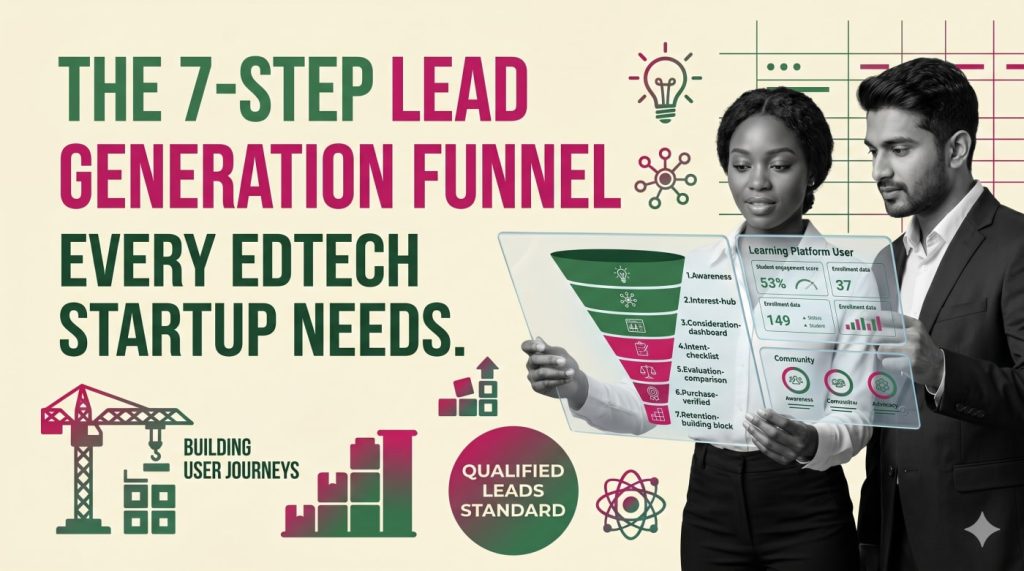
So here’s what a working lead generation system actually looks like in 2026. Not theory. Not buzzwords borrowed from a marketing textbook. Just the seven things that genuinely move the needle — and why each one matters more than most founders realize.
1. Know exactly who you’re talking to — and I mean exactly
“Everyone who wants to learn tech” is not an audience. It’s a wish dressed up as a strategy.
Think about what that phrase actually covers. A final-year engineering student deciding between a campus placement and a bootcamp has completely different fears, priorities, and objections than a 32-year-old mid-level IT professional who wants a salary bump before their next appraisal cycle. The same course might genuinely serve both of them. But the same marketing will serve neither.
Get specific. Are you primarily talking to freshers who don’t know where to start? Career switchers in their late twenties who are tired of their current field? Working professionals who need to upskill fast because their industry is changing under their feet? Freelancers trying to move upmarket? People in tier-2 cities who can’t relocate but want to compete with candidates from metros?
The narrower your answer, the better your results will be — across every single part of your marketing. Your pricing strategy, the tone of your copy, the outcomes you lead with, the testimonials you feature, the objections you address up front — all of it flows from knowing exactly who you’re speaking to. When you try to speak to everyone, you end up resonating with no one. When you speak directly to one specific person’s situation, you feel like you’re reading their mind.
2. Create content people are actually searching for — not content you feel like making
Nobody wakes up on a Tuesday morning and thinks “today’s the day I buy an online course.” That is not how purchasing decisions work, especially for something that costs a meaningful amount of money and requires a serious time commitment.
What actually happens is this: something triggers a question. A colleague gets promoted. A job listing mentions a skill they don’t have. They read an article about AI replacing certain roles. Suddenly they’re curious, slightly anxious, and they start searching. They browse for weeks, sometimes months. They read comparisons, watch YouTube videos, scroll through Reddit threads, bookmark things they mean to come back to.
That research phase is where your content needs to show up.
Think about what your specific audience is Googling right now. Not what you want them to search for — what they’re actually typing into that search bar when they’re trying to figure out their next move:
“How do I become a data engineer without a CS degree?”
“Is cloud computing still worth learning in 2026 or is it saturated?”
“What skills do AI companies actually hire for versus what they say they hire for?”
“How long does it realistically take to get a job after a data science course?”
“Best way to upskill while working full-time?”
Answer those questions honestly and completely — through blog posts, YouTube videos, LinkedIn articles, webinars, podcast appearances, whatever formats you can actually sustain. The format matters less than the consistency and the quality.
Don’t pitch inside this content. That’s the mistake most EdTech startups make. They write a blog post that’s supposed to be helpful and then spend the last third trying to sell their course. Readers can feel it. It undermines everything you built up. Just be useful. Genuinely, thoroughly, no-strings-attached useful.
Trust builds slowly and then all at once. Months of helpful content can create a connection that converts faster than any ad ever will.
3. Give them a reason to hand over their email — something actually worth downloading
Getting traffic to your website or content is one challenge. Turning that traffic into something you can build on is an entirely different one.
A lead magnet is a free, genuinely useful resource you offer in exchange for someone’s contact details. The key word there is genuinely. A five-page PDF stuffed with vague advice that could have been a Google search doesn’t count. Neither does a “free consultation” that’s really just a sales call in disguise.
What actually works: a comprehensive career roadmap PDF. A detailed salary benchmarking report for your niche. A skills assessment that helps someone figure out where they actually stand. A mini course or email series that teaches one specific, valuable thing. A curated list of resources that would have taken someone weeks to compile on their own.
Here’s the logic: if someone is reading your blog post on breaking into data engineering, they’re clearly interested in that path. Offer them a free “Complete Data Engineering Roadmap for 2026 — from zero skills to first job.” They get something that actually helps them right now. You get their email address and permission to stay in touch. Everyone wins — but only if the resource is genuinely worth downloading.
One more thing: make the ask feel low-stakes. “Download the free roadmap” converts better than “sign up for our newsletter.” People know what they’re getting and why it’s worth it.
4. Stay in touch without being annoying — this is harder than it sounds
Here’s a reality that humbles most EdTech founders: the majority of people who download your lead magnet, read your blog, or even attend your webinar will not enroll the first time they interact with you. That’s not a failure — it’s just how humans make decisions about significant purchases.
What bridges the gap is a thoughtful email nurture sequence. Not a sequence of sales emails disguised as helpful content. An actual series of genuinely useful messages sent over two to three weeks that keep you relevant in someone’s mind while they’re still in the consideration phase.
Share an insight about where the industry is heading. Send a detailed student success story — not a vague “our alumni get great jobs” claim, but a specific story about a specific person who started where your reader is and ended up somewhere they want to be. Invite them to a free live webinar. Answer a common objection in the form of a straight-talking email. Share a behind-the-scenes look at what your program actually involves.
Then, gradually and naturally, introduce your program. Not as a hard sell but as a logical next step for someone who’s been following along.
The key is that each message should feel like it was written for the person reading it, not about what you want them to do. Automation makes this scalable. Good writing makes it human. Both matter.
5. Run webinars that actually teach something people can’t easily find elsewhere
Live sessions work for one specific reason: they let prospective students experience your teaching before they commit to anything. That preview is enormously powerful in an industry where everyone claims to be the best and outcomes are hard to verify upfront.
A well-chosen topic — something like “How GenAI Is Actually Reshaping Tech Hiring in 2026 (And What Skills Are Quietly Becoming Essential)” — pulls in exactly the kind of people you want. Curious. Motivated. Already thinking about their career. Not browsing passively but actively trying to figure something out.
During the session, resist every temptation to spend the first half on your course. Lead with substance. Share data people haven’t seen. Walk through a framework that gives them a new way to think about their situation. Answer the questions they actually have, not the questions that happen to make your program sound good.
The enrollment conversation emerges naturally from a session where someone genuinely learned something. They think, “If this is what they give away for free, what must the paid program be like?” That’s the feeling you’re aiming for.
Practically: keep it to 60–75 minutes, use polling to keep people engaged, save 20 minutes for real Q&A, and follow up the same evening with a replay and a clear, low-pressure next step.
6. Have real conversations before asking for the sale — and listen more than you talk
By the time a prospect gets on a call with your counseling team, they’re already interested. They’ve read your content, attended your webinar, received your emails. They didn’t book a consultation to be convinced from scratch. They booked it because they have specific doubts they need addressed.
Cost. Time commitment. Whether their background is too limited. Whether the job market will actually absorb them on the other side. Whether they’re ready right now or should wait.
The worst thing you can do in that conversation is pitch. Launch into your program’s features, your placement statistics, your alumni network. You lose them immediately.
The best thing you can do is ask questions and then actually listen to the answers. What are they hoping to achieve, specifically? Where are they in their career right now? What’s held them back from making a move like this before? What does success look like to them in 18 months?
Once you understand their situation clearly, your job is to honestly map whether your program is the right fit for where they are and where they want to go. If it genuinely is, say so clearly and explain why in terms of their specific situation. If it isn’t — if they need something different, if the timing is wrong, if they have prerequisites they haven’t covered say that too.
Counselors who approach these conversations as career advisors trying to help someone make the right decision close significantly more enrollments than those running a sales script. Every single time. And the students they enroll are better ones — more committed, more likely to complete, more likely to become the kind of alumni who refer others.
7. Look at your numbers honestly — and fix one thing at a time
Most EdTech startups build their lead generation funnel, launch it, and then largely move on. They treat it as infrastructure rather than a living system. The ones that actually grow keep tinkering, keep measuring, keep asking where the friction is.
Your funnel has five or six stages, and each one has a conversion rate worth tracking. What percentage of your content visitors download your lead magnet? What’s your email open rate, and more importantly, your click-through rate? How many people who receive your webinar invite actually attend? What percentage of attendees book a consultation? What percentage of consultations turn into enrollments?
Each number tells you where the leak is. And every funnel leaks somewhere — the question is where yours leaks most.
Low webinar attendance despite solid registration numbers? Your reminder email sequence needs work — probably more specific, more urgent, more personal. High attendance but very few consultations booked afterward? Something is off in your closing call-to-action or your follow-up email. Lots of consultations but a disappointing enrollment rate? Time to listen back to those calls and figure out which objections aren’t being handled well.
You don’t need to fix everything at once. Trying to optimize six things simultaneously usually means optimizing none of them well. Find the weakest link, fix it, measure again. Repeat.
Know who you’re targeting, precisely and specifically. Create content that genuinely helps them during the research phase. Capture their contact details with something actually worth downloading. Nurture them through a series of helpful, human emails. Show your expertise live through webinars where you lead with substance. Have real conversations rather than running sales scripts. Measure your funnel honestly and improve the weakest part first.
That’s it. Seven things, none of them revolutionary, all of them requiring consistency over weeks and months rather than a single burst of effort.
The EdTech startups winning right now — the ones quietly compounding enrollment month over month — aren’t the ones with the biggest advertising budgets or the most sophisticated tech stacks. They’re the ones who understood that lead generation is a system, built that system thoughtfully, and then actually stuck with it long enough to see it work.
Not magic. Not a secret. Just consistency applied to the right things.