“You Need Experience to Get a Job. You Need a Job to Get Experience.”
“You Need Experience to Get a Job. You Need a Job to Get Experience.”
Sound familiar?
If you’ve ever applied for jobs as a fresher, chances are you’ve come across a requirement that made you stop dead in your tracks—equal parts absurd and infuriating:
“Entry-level position. Minimum 2 years of experience required.”
You read it twice. Maybe three times. And then the same question that’s haunted every new graduate before you rises up almost automatically:
“Where exactly am I supposed to get those two years of experience if nobody will hire me in the first place?”
It feels like a riddle without an answer. A door that’s been locked from the inside. And no matter how hard you knock, nobody seems to be opening it.
This is one of the most frustrating realities of today’s job market—and it’s not something you imagined or exaggerated. It’s real, it’s widespread, and it affects thousands of bright, capable, hard-working people every single year. More importantly, it’s a problem that can be solved—once you understand what’s actually going on beneath the surface.
The Gap Between Expectation and Reality
Every year, a new wave of graduates walks out of colleges and universities with degrees in hand, certificates on their resumes, and a genuine belief that they’re ready. They’ve spent years working toward this moment—attending lectures, pulling late nights before exams, completing coursework, and maybe even picking up extra skills through online platforms and self-study.
They did everything they were told to do.
And then they enter the job market.
Applications go out. Days pass. Then weeks. The responses that do come back are polite, generic rejection emails. Some applications don’t even get a reply at all. The interviews that do happen somehow don’t convert. And slowly, the excitement that carried them through graduation starts to give way to something harder — self-doubt.
“Am I not good enough?”
“Did I choose the wrong field?”
“Did I learn the wrong things?”
“What exactly are companies looking for, and why does nobody tell you before you graduate?”
These aren’t dramatic thoughts. They’re the honest, private conversations that thousands of freshers have with themselves after months of trying. And if you’ve been there, you know exactly how heavy that silence feels — the silence of an inbox that isn’t filling up the way you hoped it would.
Here’s something most people don’t say out loud: this phase is genuinely difficult. It’s not a sign of weakness to struggle with it. The gap between academic life and professional life is wide, and crossing it requires more than just submitting applications and hoping for the best.
The Real Problem Isn’t What You Think
Here’s something important to understand—something that often gets lost in the noise of job-hunting advice:
The problem, in most cases, isn’t your intelligence. It isn’t your work ethic. It isn’t even your degree or the institution you graduated from.
The problem is a gap — a very specific kind of gap — between what you know and what you’ve done.
Most graduates today actually know quite a lot. They’ve studied programming languages, business strategy, data analytics, cloud infrastructure, marketing funnels, financial modeling, or engineering principles. Many have gone further — layering certifications and online courses on top of their formal education, trying to stay ahead of what the market wants.
But knowledge alone, it turns out, isn’t quite enough anymore.
When a recruiter looks at your resume, they aren’t just checking whether you covered certain topics in your degree. They’re asking themselves a different, more practical question: Can this person actually do the work?
A hiring manager doesn’t just want to know whether you understand SQL. They want to know if you’ve ever used it to pull insights from a messy, real-world dataset and turned those insights into something useful. A startup isn’t only interested in whether you studied machine learning. They want to know whether you’ve built something with it—something that worked, something that failed, something that taught you how to get better.
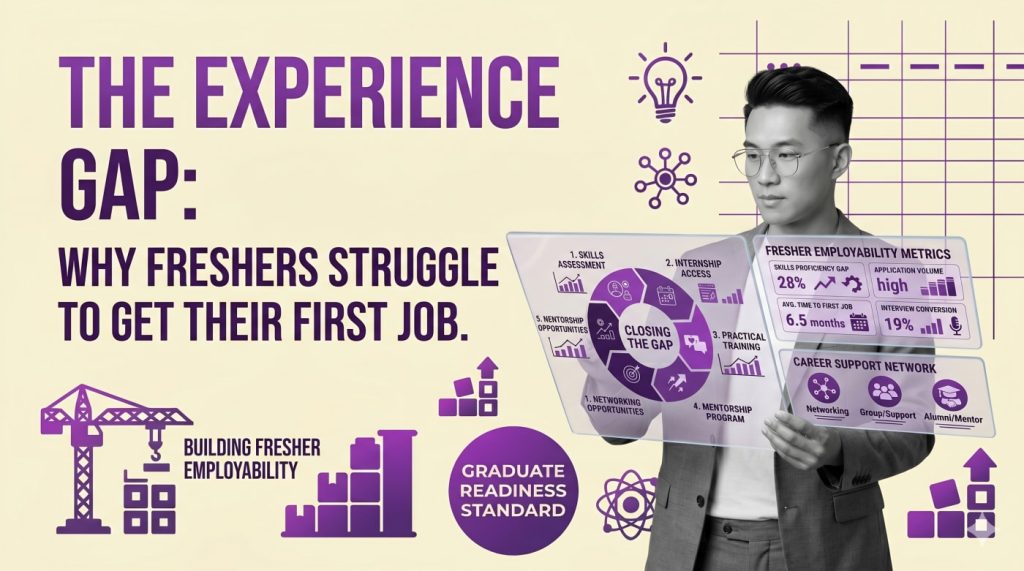
This is what recruiters and career coaches often call the experience gap. And right now, it’s quietly sitting at the heart of why so many freshers struggle to get their foot through the door, no matter how many applications they send out.
Why Companies Keep Asking for What You Don’t Have
From where you’re standing, the whole thing can feel deeply unfair. And honestly? A part of that feeling is completely justified.
But it helps to understand the other side of the equation — not to excuse it, but to know what you’re actually up against.
When a company hires someone, they’re not just adding a name to their team. They’re making an investment. There’s the time spent onboarding. The mental bandwidth of a manager who has to explain, guide, and support. The cost of mistakes made during the learning curve. The slower output while someone is still finding their footing.
An experienced hire shortens that curve dramatically. They’ve already made many of the beginner mistakes on someone else’s time. They know how to navigate a professional environment, manage expectations, communicate with stakeholders, and deliver work without needing every step spelled out.
A fresher, on the other hand, comes in with potential—genuine potential—but potential that still needs to be unlocked. That requires investment from the company’s side, and not every team has the bandwidth, budget, or patience to make that investment.
None of this means companies don’t want freshers. They absolutely do — and in fact, many companies actively prefer freshers for certain roles because they’re easier to shape, more open to learning, and often more energetic than experienced hires who come with their own ingrained habits. But they want freshers who can demonstrate that they’ve thought beyond the classroom.
What companies are really asking for, underneath all the “years of experience” requirements, is evidence. Evidence that you’ve worked on something real. Evidence that you can handle ambiguity, solve problems, and show up like a professional. Evidence that hiring you is less of a leap of faith and more of a calculated, confident decision.
The good news? Evidence is something you can build — even before you have a job.
The Rules Changed — And Nobody Sent You the Memo
There’s a generational shift happening in hiring, and it’s one that many educational systems haven’t fully caught up with yet.
A generation ago, the path was fairly predictable. You studied hard, earned your degree, graduated, and applied for jobs. The degree itself was the signal — it told employers you were capable, disciplined, and worth investing in. That was often enough.
Today, that signal has gotten noisier. More people have degrees than ever before. Degrees have become necessary, but they’re no longer sufficient on their own. They’ve become the baseline, not the differentiator.
The result? Recruiters now come to the table with a different set of questions:
What have you built? Have you worked on real problems, even outside a classroom? Do you have an internship on your resume—or if not, do you at least have projects that demonstrate what an internship would have taught you? Can you show me your GitHub, your portfolio, your work? Is there anything I can look at that tells me who you are beyond the grades on your transcript?
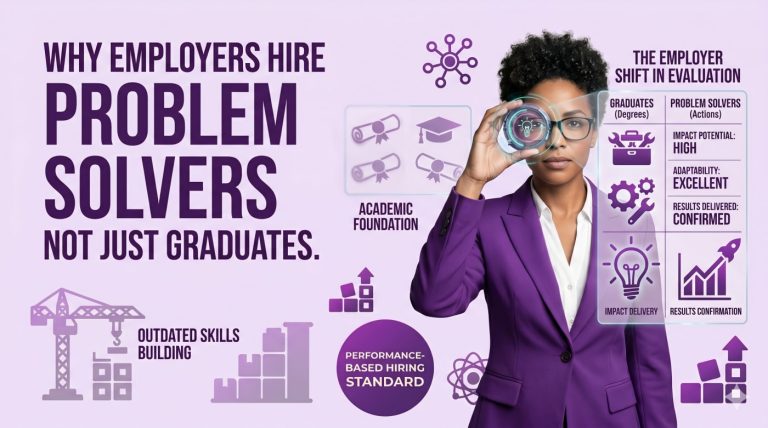
The hiring process has quietly shifted from “What did you learn?” to “What can you actually do?” And that’s a significant adjustment for anyone who was raised in a system that told them academic performance was the primary goal.
It’s not that academic performance doesn’t matter — it does. A strong GPA, a relevant degree, and a well-known institution still open doors. But the job market has added a second layer of evaluation, and many freshers are caught off guard when they encounter it for the first time. They feel blindsided — and that’s entirely understandable, because nobody explicitly told them this was coming.
What Actually Closes the Experience Gap
So what does closing the experience gap actually look like in practice? Because understanding the problem is one thing — but knowing what to do about it is what really matters.
The freshers who successfully break through this cycle aren’t always the most talented people in the room. They’re often the ones who understood the rules of the game early enough to play differently.
Here are the approaches that consistently make a difference:
Projects that solve real problems. Not just tutorial projects from YouTube and not just assignments submitted for a grade—but personal projects where you identified a problem, made decisions, hit obstacles, and shipped something. It doesn’t have to be perfect. It has to be yours. A working app, a data analysis report you built from scratch, a marketing campaign you ran for a local business — these things are worth more on your resume than most people realise.
Internships and freelance work. Even a short, unpaid internship at a small company can be transformative. It puts you inside a professional environment, forces you to work with people you didn’t choose, exposes you to the pace and pressure of real deliverables, and gives you something credible to talk about in interviews. If formal internships aren’t available, freelance work — even small projects for clients you find through your network or platforms like Fiverr or LinkedIn — counts.
Open-source contributions. For those in tech, contributing to open-source projects on GitHub is one of the most underrated resume-builders available. It shows technical ability, demonstrates that you can work within an existing codebase, and gives recruiters something concrete to look at beyond your academic transcript.
Certifications with practical components. Not all certifications are created equal. The ones that carry weight are the ones that involve building something or completing applied projects — not just passing a multiple-choice exam. Look for certifications that require a capstone project, case study, or portfolio submission.
Writing and documentation. If you can clearly explain what you did, why you did it, and what you learned, you immediately stand out. A blog post breaking down a project you built. A case study showing your thought process. A LinkedIn article sharing what you learned from a course. These signal communication skills, which every employer values, and they create a digital trail of your thinking.
Networking with intention. Many jobs — especially at the entry level — are filled before they’re ever publicly posted. Building genuine relationships with people working in your target industry, attending events, engaging thoughtfully in professional communities online, and asking for informational interviews can put you in front of opportunities that nobody else even knows exist.
None of these require a job. All of them build the evidence that gets you one.
The Mental Game of the Job Search
There’s something else that doesn’t get talked about enough in career advice: the psychological toll of the early job search.
Rejection is hard. Silence is somehow harder. When weeks turn into months and the results aren’t coming, it’s natural to start questioning yourself — your choices, your abilities, your worth. That internal narrative can become a real obstacle, not because it’s true, but because it starts to affect the energy and confidence you bring into interviews and applications.
Here’s what’s important to hold onto: the experience gap is a structural problem, not a personal failing. The job market as it currently operates creates a situation where the requirements for entry-level roles routinely exceed what entry-level candidates could reasonably be expected to have. That’s a real, documented issue — not your imagination, not an excuse.
At the same time, dwelling on the unfairness of it doesn’t close the gap. What closes it is action — targeted, strategic, consistent action, even when the results feel slow in coming.
Keep a record of what you’re doing. Track every application, every project completed, every new skill added. On the days when the inbox is quiet and the doubt is loud, that record reminds you that you’re moving forward, even when it doesn’t feel like it.
You’re Not Behind. You’re Just Navigating a System That Didn’t Explain Itself.
The most important thing to understand — and hold onto — is this: you are not behind. You are navigating a system that shifted its expectations without giving anyone a proper heads-up. And that’s a very different thing.
The freshers who break through this cycle aren’t superhuman. They’re not uniquely brilliant or exceptionally lucky. They’re the ones who understood what the market was actually asking for, and then set about building it — one project, one conversation, one opportunity at a time.
The experience gap is real. It’s frustrating. It’s genuinely unfair in some of the ways it manifests. But it isn’t permanent. And it isn’t insurmountable.
The fact that you’re here — reading this, asking the right questions, thinking seriously about what comes next — already puts you ahead of where many others start. Most people keep sending the same applications and expecting different results. You’re looking for a different approach.
That instinct is the right one. Now it’s time to act on it.