
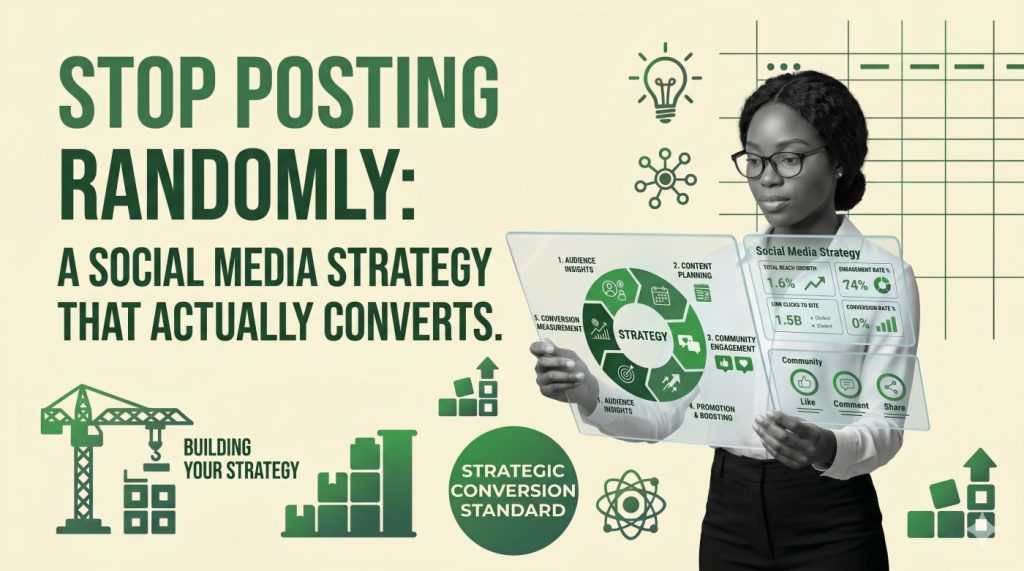
Why Posting Every Day Isn’t Enough Anymore
Let me be honest with you about something that most marketing advice consistently gets wrong—something that’s costing businesses time, money, and real opportunity every single day.
For the longest time, the golden rule of social media was refreshingly simple: post every day, stay consistent, and the growth will follow. Show up, stay active, keep the content flowing, and the algorithm gods will eventually reward your loyalty.
Sounds reasonable. Even logical. Except it’s not working for most businesses anymore — and if you’ve been following that advice, you’ve probably already figured that out the hard way.
I see brands posting five, sometimes six times a day. Good content, decent visuals, regular schedules, consistent themes. And they’re still barely generating a single meaningful inquiry. Not a DM. Not a click. Not a conversation that goes anywhere. Just silence, and a slowly growing sense that all this effort is going into a void.
That’s not a content problem. That’s a strategy problem. And there’s a difference.
We Confused Being Active With Having a Strategy
Here’s the real issue, and it’s one that’s surprisingly easy to fall into.
Think about what a typical week looks like for most business accounts on Instagram, LinkedIn, or Facebook:
Monday — a motivational quote with a pretty background.
Tuesday — a product or service promotion with a generic caption.
Wednesday — a trending meme, because someone said engagement is up on memes.
Thursday — a team photo from last Friday’s lunch.
Friday — another service ad, essentially the same as Tuesday’s.
Each post exists in its own little bubble. There’s no thread connecting them. No story being told. No consistent message being reinforced. No clear reason why someone should care or come back.
And if you’re a new visitor — someone who’s just stumbled across your profile for the very first time — you’d scroll through and have absolutely no idea what this brand actually stands for, who it helps, or why you should pay attention.
It’s a bit like walking into a shop where the salesperson randomly switches between talking about the weather, pushing a product, cracking a joke, showing you a family photo, and then trying to get you to sign up for something. Confusing, right? You’d probably smile politely and leave without buying a single thing.
That is precisely what random, unconnected posting does to your audience online. It doesn’t build familiarity. It doesn’t build trust. It just adds noise to an already noisy feed.
The Shift That Actually Changes Everything
So what’s the alternative? It starts with one simple question — and I mean genuinely asking it, not just going through the motions.
Before you create any piece of content, ask: What is this supposed to do?
Not in a cold, overly calculated way. But genuinely. Is this post helping someone discover you for the first time? Is it starting a conversation? Is it building trust with someone who’s been on the fence? Is it nudging someone to take a next step?
Every piece of content should have a job. A purpose. A reason it exists beyond filling a slot on a content calendar.
When your content has a job, your social media stops being a time-consuming obligation and starts functioning as an actual growth channel. That shift sounds small, but the impact is enormous.
The brands that are genuinely winning on social media right now aren’t the ones posting the most. They’re the ones posting with the most intention.
What Actually Works — And More Importantly, Why
The brands doing this well tend to lean on five types of content. Not randomly and not interchangeably, but with a clear sense of what each type is meant to accomplish.
1. Content That Teaches
Share what you know. Genuinely. Industry insights, common mistakes people make, trends worth paying attention to, how-things-work explainers that make your audience feel smarter for having read them.
This kind of educational content does something that promotional content simply cannot: it builds trust at scale. When someone consistently learns something valuable from your page, they stop seeing you as a brand trying to sell them something. They start seeing you as a resource — someone worth listening to. And trust, real trust, converts far better than familiarity ever will.
Think about the accounts you personally follow. The ones you actually pay attention to. Chances are, they’ve taught you something. They’ve helped you understand something you didn’t before. That’s not an accident.
2. Content That Speaks to Real Struggles
This is where most businesses dramatically miss the mark. They create content about their solutions before they’ve acknowledged the problems their audience is living with.
A fresher who’s been rejected from twenty jobs in a row doesn’t need another course promotion in their feed. They need someone to see them — to acknowledge what they’re going through, to validate that it’s hard, and to offer a genuinely realistic path forward. Start there.
When you show your audience that you understand their day-to-day frustrations, their quiet fears, their unspoken questions — they lean in. Suddenly you’re not a brand talking at them. You’re a brand talking to them. That distinction matters more than people realise.
3. Content That Shows Real Results
Social proof is not new. But the way most brands use it is completely wrong.
Polished testimonials that sound like they’ve been written by a copywriter and vetted by a legal team don’t move people. They read as staged, and people can feel that.
What works is real stories. Messy ones, even. Someone who made a difficult career shift and didn’t know if it was the right call. Someone who landed their first job after months of nothing and felt overwhelmed with relief. Someone who finally understood a concept they’d been struggling with for years and had an actual lightbulb moment.
That kind of proof does more heavy lifting than any clever copy ever could. It’s specific, it’s human, and it gives your audience permission to believe that they could experience something similar.
4. Behind-the-Scenes Content
This one is chronically underused, especially by smaller businesses and startups who think they don’t have anything interesting to show.
Your team. Your process. The messy middle of building something. The conversations that happen before the polished product exists. The decisions that didn’t go perfectly. The things you tried that didn’t work and what you learned from them.
People don’t just buy products or services anymore. They buy into the people behind them and the mission driving them. When you let your audience see the real version of your business — the human version — you’re not just building awareness. You’re building genuine affinity.
And affinity is the thing that keeps someone coming back, referring others, and choosing you over a cheaper competitor who feels less familiar.
5. Content That Actually Asks for Action
Here’s where so many brands drop the ball entirely, and it genuinely baffles me every time I see it.
They do the hard work. They create educational content, they share real stories, they build genuine trust over weeks and months. And then… nothing. No ask. No next step. No invitation to go deeper.
A clear, well-timed call to action isn’t pushy. It’s not aggressive. It’s not salesy in a bad way. It’s just good direction. Your audience has been warming up, they’ve been learning to trust you, and they’re often waiting for a reason to act. Give them one.
“Download this free guide.” “Book a free call to talk through your situation.” “Reply and tell me where you’re stuck.” Simple, direct, human. That’s all it needs to be.
The Content Ratio Most Brands Get Completely Backwards
Here’s a rough guide that works consistently well across industries: aim to spend roughly 70% of your content delivering genuine value, 20% building credibility through proof and real stories, and 10% on direct promotion and clear calls to action.
Most businesses do almost the exact opposite. Seventy percent promotional content, thirty percent everything else. Then they’re puzzled and frustrated when people scroll straight past.
Think about why you follow the accounts you follow. Is it because they constantly push their products at you? Almost certainly not. You follow them because they help you, entertain you, or make you think. The same logic applies to your audience.
People follow accounts that genuinely serve them. Not accounts that treat their feed like a billboard.
Stop Measuring the Wrong Things
Likes feel good. A growing follower count feels impressive at a dinner table. Screenshots of big view numbers feel worth sharing.
But here’s the uncomfortable reality: if none of that translates into actual conversations, website clicks, or paying customers — it’s just noise. Expensive, time-consuming noise.
A post that reaches 500 people and generates 20 genuine inquiries is worth infinitely more than one that goes semi-viral with 50,000 views and produces zero meaningful action. These are not comparable outcomes, even though one of them looks far more impressive on the surface.
The metrics worth actually caring about are the ones connected to business outcomes. How many people clicked through to your website? How many sent you a message? How many booked a call? How many became customers?
Everything else is vanity. And vanity doesn’t pay the bills.
Consistency Still Matters — But Not the Way You’ve Been Told
None of this means you should stop showing up regularly. Consistency still matters enormously for building trust and staying front of mind with your audience.
But there’s a meaningful difference between posting consistently and posting mindlessly.
Consistent posting means your audience knows you’re there, knows what to expect from you, and can rely on you to show up with something worth their time. Mindless posting means filling a schedule for its own sake, regardless of whether what you’re putting out actually serves anyone.
The goal isn’t to post seven times a week. The goal is to give someone a reason to follow you, come back, and eventually trust you enough to want to work with you. Sometimes that happens with three thoughtful posts a week. Sometimes less. The frequency matters far less than the intention behind it.
Social Media Is the Starting Point, Not the Whole Journey
One of the most important reframes for any business owner is this: social media is the beginning of the customer journey, not the entire journey.
It sounds obvious when you say it out loud. But most social media strategies are built as if a like or a follow is the destination, rather than the very first step.
The actual journey looks more like this: someone discovers a genuinely helpful post → they follow you to see more → they learn from your content over time → they download something useful or attend something you’re running → they book a call or reach out directly → they become a customer and, eventually, someone who tells others about you.
That’s a funnel. It has stages, it has momentum, and it moves people forward. Without it, even your best content disappears into the scroll and leaves no trace.
Your social media content should be designed to move people from one stage to the next—not just to generate impressions. Every post is an opportunity to deepen a relationship that’s already begun or to start one that hasn’t yet.
SEO and Social Media: They Work Better Together Than You Think
Here’s something worth adding if your goal is specifically to improve your website’s visibility: social media and SEO are not separate strategies. They reinforce each other in ways that most businesses completely overlook.
When you consistently publish content around specific topics—the problems your audience faces, the skills they want to build, the industries you work in—you’re doing two things at once. You’re building trust with your audience in real time, and you’re creating a body of work that signals to search engines what your brand is actually about.
The keywords your audience uses when they search for help? Those are the same words you should be weaving into your social content, your website copy, and your blog posts. Not awkwardly, not in a way that feels forced, but naturally—because you’re genuinely talking about the things your audience cares about.
Educational content, in particular, performs exceptionally well for SEO. When you write a detailed, genuinely useful piece about a topic your audience is searching for, you’re not just helping a follower who sees it in their feed. You’re creating something that can rank in search results, drive organic traffic, and bring people to your website who didn’t even know you existed yet.
The brands that understand this treat every piece of content as an investment — not just in today’s engagement, but in tomorrow’s discoverability.
One Question Before You Hit Publish
Before you post anything — anything at all — just pause and ask yourself one question:
Is this moving someone closer to working with me, or is it just filling a slot on my content calendar?
That question alone will change how you think about social media. It will change what you create, why you create it, and what you actually get back from the effort you put in.
The content calendar isn’t the point. The relationship is. The trust is. The moment someone decides that you’re the right person or the right team to help them — that’s the point.
Everything before that moment is just preparation.
A Final Thought
None of this requires a massive team, a professional studio, or an enormous budget. It requires clarity about who you’re talking to, genuine understanding of what they’re struggling with, and the patience to build something real instead of chasing metrics that look good but mean nothing.
The brands that grow sustainably on social media aren’t the loudest ones. They’re the most useful ones. The ones that show up with something worth reading, watching, or thinking about. The ones that make their audience feel understood rather than targeted.
That’s the kind of marketing that doesn’t feel like marketing. It just feels like someone who genuinely gets it and genuinely wants to help.
At Intellea, this is how we think about everything we do. Whether it’s generative AI, data engineering, or building multi-cloud skills, the approach is always the same: lead with real value, earn trust before you ask for anything, and make every piece of content do a job worth doing.
That’s the strategy. Everything else is just noise.