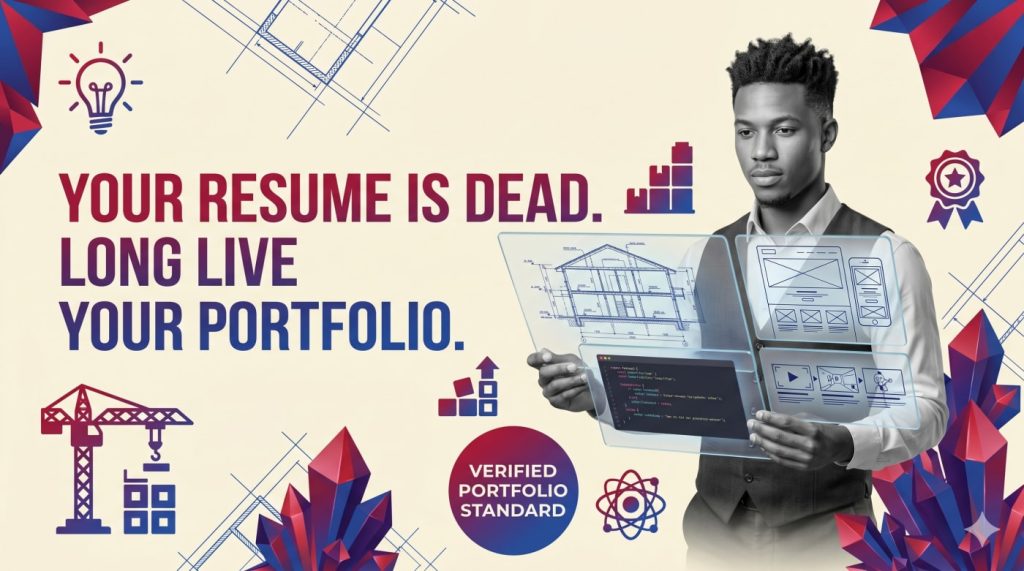
Your Resume Isn’t Dead. But It’s Definitely Losing the Plot.
Here’s something a bit uncomfortable: right now, somewhere, a recruiter is scrolling through 500 resumes. And by number 237, they’re running almost entirely on autopilot.
Because every single resume says the same thing.
Python. SQL. Team player. Fast learner. Passionate about data.
Sure. Everyone is.
The problem is not that people are lying. The problem is that everyone sounds identical. And when everyone sounds identical, the resume stops being a useful document. It becomes a formality. A checkbox. A ticket that gets you into the room, nothing more. The real question is, what happens once you’re in the room, and more importantly, how do you even get there in the first place?
What Actually Changed in Hiring
For a long time, the hiring process followed a clean, predictable path. You studied; you graduated; you made a resume; you got a job. The formula worked because the world moved slowly enough for it to work.
But something shifted over the last decade. Technology started moving faster than universities could keep up with. The skills that were cutting edge in a second-year curriculum were already becoming standard by graduation. Companies, especially in tech and data, began asking a fundamentally different question. Not “did you take a course in this?” But “Have you actually built anything with it?”
That gap between claiming a skill and demonstrating one is enormous. It’s the difference between someone who says they can cook and someone who puts a plate of food in front of you. One requires trust. The other is just evidence. And employers, particularly in data engineering, software development, AI, and product roles, have figured that out very quickly.
This is not just a trend. It’s a structural shift in how companies evaluate talent, and it’s not going back.
Two People, One Job Opening
Let’s make this concrete. Arjun and Maya graduated from the same university, in the same course, in the same year. Both of them applied for a data engineering role at a mid-sized tech company.
Arjun listed SQL, Python, Azure, and Apache Spark on his resume. He had a college project from his second year about a library management system. Clean formatting, good structure—nothing wrong with it.
Maya had a GitHub repository with a real Azure Data Factory pipeline she had built from scratch. A Databricks ETL project that processed public data and generated meaningful output. Architecture diagrams explaining her design decisions. A short blog post walking through a problem she ran into mid-project and how she worked through it. A screen recording showing the whole thing in action, end to end.
The recruiter stopped reading and started exploring.
One of them got the interview. You already know which one.
This is not a story about Maya being smarter than Arjun. It’s a story about evidence. Arjun described what he could do. Maya showed what she had done. In a competitive market, that difference is everything.
The Real Problem With Most Resumes
Most resumes read like movie trailers written by someone who has never actually seen the film.
“Dynamic professional with exceptional leadership capabilities and innovative problem-solving skills who thrives in fast-paced environments.”
Translation: organized a college event once. Maybe two.
Recruiters are not cynical people. They’re just experienced. They’ve read ten thousand versions of the same document. They’ve learned to read between the lines, and what they often see between the lines is a lot of nothing. The language is inflated, the evidence is thin, and the actual capability of the person remains completely invisible.
A portfolio removes all of that noise. There is no translation required. The work is right there. You can look at the code, read the case study, watch the demo, and navigate the project. No interpretation needed. The recruiter does not have to trust you because they do not have to trust you. They can just see.
This is why portfolios are increasingly becoming the real filter, not the resume. The resume gets you past an automated system. The portfolio gets you past a human being.
What Strong Portfolios Actually Look Like Across Different Fields
The word “portfolio” can feel intimidating, like it belongs to designers with beautiful Behance pages and photographers with lightbox galleries. But a portfolio is really just organized, visible evidence of your work. What that looks like depends entirely on what you do.
For software developers, data engineers, and AI practitioners, GitHub is the obvious home. A well-maintained profile with real projects, clear README files, and some commit history tells a story that no resume can match. Recruiters in technical fields actively search GitHub. If your profile is empty or shows only forked repositories you never touched, that is itself a signal.
For designers, Behance and Dribbble remain strong platforms, but a personal website with detailed case studies tends to perform better in senior roles. The case study format matters here because it shows not just what you designed but why you made the decisions you made. That reasoning is what separates a designer from a great designer.
For product managers, the portfolio looks different again. There are no code files to share and often no finished products you can publicly display. What you can share is your thinking. A one-page case study on a product problem you identified, how you framed it, what research you did, what trade-offs you considered, and what you would build. Even as a side project, even as a hypothetical, it demonstrates exactly the kind of structured thinking that product roles require.
For marketers and content creators, a simple collection of your work with context around results is powerful. Not just “I wrote this article” but “I wrote this article, it reached X readers, and here is what we learned from the engagement data.”
The throughline across all of these is the same. Real work, visible evidence, honest explanation of your process. That combination is what makes a portfolio worth looking at.
The Formula That Actually Works
Here is the process, stripped down to its simplest form.
Learn something. Then build something with it. Then share what you built somewhere people can actually find it. Then let that work bring the opportunities to you.
Learn. Build. Share. Get noticed.
It sounds almost too simple, and that’s partly why people skip straight from the first step to the fourth and wonder why nothing is happening. The middle two steps are where the actual work lives.
Building is what most people avoid. Not because they are lazy, but because building feels exposed. You are putting something out into the world that is not perfect, that might have bugs, that someone might criticize. There is always another course to finish first, another tutorial to watch, another certification to add to the list. And none of it substitutes for actually making something.
Building creates evidence. Evidence does the convincing for you. Every project you complete is a demonstration that you can take an idea from nothing to something functional, which is ultimately what every employer is paying you to do.
But What Should You Actually Build?
This is where a lot of people get stuck. They want to build something impressive, and so they end up building nothing while waiting for a good enough idea.
The bar is lower than you think, especially when you are starting out.
For someone in data, a basic ETL pipeline pulling from a public API and loading into a database is a real project. An analysis of a public dataset with a clear question, clean visualizations, and a write-up of your findings is a real project. A dashboard built in Tableau, Power BI, or even Python showing something interesting about a topic you actually care about is a real project.
For developers, a web scraper with a simple frontend. A command line tool that solves a problem you personally had. A small web application with user authentication and a database. None of these need to be groundbreaking. They need to be real, functional, and explained clearly.
The explanation matters almost as much as the project itself. A short README or blog post that describes what you built, why you built it, what problems you ran into, and what you would do differently next time shows a level of self-awareness and communication skill that is deeply attractive to hiring managers. Most candidates cannot explain their own thinking clearly. If you can, you stand out.
Where to Share Your Work
Once you have built something, the sharing part is often underestimated. Putting a project on GitHub is necessary but not sufficient. You also need to point people toward it.
A LinkedIn post walking through what you built, what you learned, and what surprised you about the process gets significantly more visibility than most people expect. Technical LinkedIn content is genuinely underrepresented relative to the audience that wants to see it. If you work in data, software, AI, or any technical domain, your thoughtful post about a project you built is likely to be seen by recruiters and hiring managers who are actively looking for exactly what you are demonstrating.
You do not need a perfect personal website with custom animations and a newsletter. A clear GitHub profile, one or two explained projects, and some visibility on LinkedIn are enough to differentiate yourself from the majority of applicants in most markets.
The goal is not to become famous. The goal is to be findable and credible when someone who wants to hire you goes looking.
Is the Resume Completely Dead?
Not quite, but its role has changed significantly.
Think of it this way. The resume is the movie poster. It gets you noticed, it tells you the genre, and it gives you just enough to decide whether you want to know more. But nobody walks out of a cinema talking about the poster. The film is what people remember.
You still need the poster. Automated applicant tracking systems filter on resume keywords before any human ever sees your application. Recruiters use resumes to organize candidates and set up interview conversations. The resume still has a functional role in the process.
But the resume is increasingly just the entry point. What gets you past the first conversation, what gets you the second call, and what gets you to the offer is the evidence you can point to. And that evidence lives in your portfolio.
The candidates who understand this are not thinking about how to make their resume more impressive. They are thinking about what they can build next.
The Specific Shift That Changes Everything
There is one mental shift that separates candidates who consistently get shortlisted from candidates who keep disappearing into the stack.
Most candidates focus on what they can do. Promising employers that they have the skills, the attitude, the potential. And that is fine. But it requires the employer to take a leap of faith, to trust the promise, and to project confidence onto someone they have known for twenty minutes in an interview.
The candidates who build portfolios are doing something different. They are not asking employers to trust them. They are showing employers what already exists. Not “I can do this” but “here is something I already did.”
That shift, from promising to proving, is the entire game. It removes doubt from the hiring process. It answers the question every hiring manager is actually asking, which is not “can this person learn this?” but “has this person already done this?”
When you can answer that second question with a link, the conversation changes completely.
A Practical Place to Start
If you are reading this and feeling the gap between where you are and where you want to be, here is the most honest advice available.
Pick one project. Something small enough to finish in two to four weeks. Something that uses a skill you are trying to demonstrate. Build it to completion, not perfection. Write two paragraphs explaining what it is, why you built it, and what you learned. Put it somewhere public. Share the link once on LinkedIn with a brief explanation.
That is it. That is the starting point. One project, shared publicly, with honest context around it.
From there, the next one is easier. And the one after that. Over six months of consistent building, you will have a portfolio that tells a genuine story about who you are and what you are capable of. And that story will do more for your career than any resume ever could.
The Work Speaks Louder Than the Words
The most powerful thing you can say in a job search is not “I know how to do this.” Anyone can say that. Everyone does say that.
The most powerful thing you can say is “Here is what I have already done.”
That shift, from promising to proving, from describing to demonstrating, is what separates the candidates who get shortlisted from the ones who become part of the stack.
So build something. Anything real, anything finished, anything you can point to and explain. Put it somewhere people can find it. Let the work carry the conversation.
Because at the end of the day, the work speaks. And it speaks louder than anything you could ever write about yourself on a resume.